Memory Allocation
Memory Allocation
- Dynamic memory allocation
- Size/ number of data stuctures may only be known at run time
- Need to allocate space on the heap
- Need to de-allocate (free) unused memory so it can be re-allocated
- Implementation
- Implicit free lists
- Explicit free lists
- Sefregated free lists
- Garbage collection
- Commobly memory-related bugs in C programs
Implicit Memory Allocation: Garbage Collection
Garbage collection
- Automatic reclamation of heap-allocated storage- application never has to free
void foo()
{
    int *p = (int *)malloc(128);
    return; /*p block is now garbage */
}
-
Common in functional languages, scripting languages, and modern object oriented languages:
- Lisp, ML, Java, Perl, Mathematica
-
Variants (“conservative” garbage collectors) exist for C and C++
- However, cannot necessarilly collect all garbage
-
How does the memory allocator know when memory can be freed?
- In general, we cannot know what is going to be used in the future since it depends on conditions
- But, we can tell that certain blocks cannot be used if there are no pointers to them
-
So the memory allocator needs to know what is a pointer and what is not - how can it do this?
-
We’ll make some assumptions about pointers:
- Memory allocator can distinguish pointers from non-pointers
- All pointers point to the start of a block in the heap
- Application cannot hide pointers (e.g., by coercing them to an int, and then back again)
Classical GC Algorithms
- Mark-and-sweep collection (McCarthy, 1960)
- Does not move blocks (unless you also “compact”)
- Refenrece counting (Collins, 1960)
- Does not move blocks (not discussed)
- Copying collection (Minsky, 1963)
- Moves blocks (not discussed)
- Generational Collectors (Lieberman and Hewitt, 1083)
- Collection based on lifetimes
- Most allocatotions become garbage very soon
- So focus reclamation work on zones of memory recently allocated
- Collection based on lifetimes
- Resources: Jone and Lin, “Garbage Collection: Algorithms for Automatic Dynamic Memory”, John Wiley & Sons, 1996
Memory as a Graph
- We view memory as a directed graph
- Each allocated heap block is a node in the graph
- Each pointer is an edge in the graph
- Locations not in the heap that contain pointers into the heap are called root nodes (e.g. registers, locations on the stack, global variables)
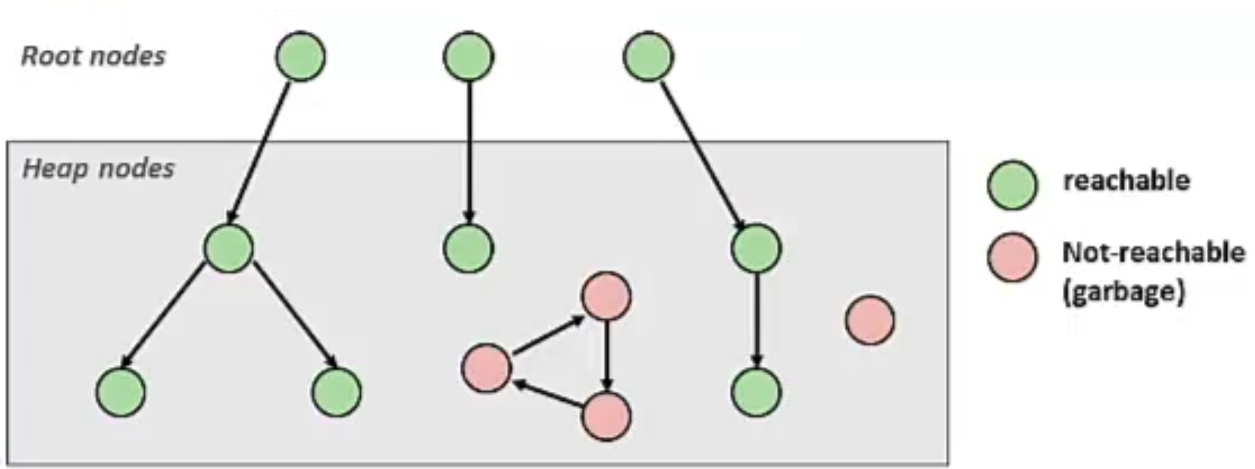
- A node (block) is reachable if there is a path from any root to that node
- Non-reachable nodes are garbage (cannot be needed by the application)
Mark and Sweep Collection
-
Can build on top of malloc/ free package
- Allocate using malloc until you “run out of space”
-
When out of space:
- Use extra mark bit in the head of each block
- Mark: Start at roots and set mark bit on each reachable block
- Sweep: Scan all blocks and free blocks that are not marked
Assumptions For a Simple Implementation
-
Application can use functions such as:
new(n): returns pointer to new block with all locations clearedread(b,i): read locations i of block b into registerb[i]
write(b, i, v): write v into location i of block bb[i] = v
-
Each block will have a header word
b[-1]
-
Functions used by the garbage collector:
is_ptr(p): determines whether p is a pointer to a block.length(p): returns length of block pointed to by p, not including headerget_roots(): returns all the roots
-
Mark using depth-first traversal of the memory graph
prt mark(ptr p)
{
	if (!is_ptr(p)) return;				// p: some word in a heap block
	if (markBitSet(p)) return;		// do nothing if not pointer
	setMarkBit(p);								// check if already marked
	for (i=0; i < length(p) i++)	// set the mark bit
		mark(p[i]);									// recursively call mark on
	return;												//  all words in the block
}
- Sweep using lengths to find next block
prt sweep(ptr p, ptr end)				// prts to start & end of heap
{																// while not at end of heap
	while (p < end) {
		if markBitSet(p)						// check if block is marked
			clearMarkBit();						// if so, reset mark bit
		else if (allocateBitSet(p))	// if not marked, but allocated
			free(p)										// free the block
		p += length(p);							// adjust pointer to next block
	}
}
Conservative Mark & Sweep in C
- Would mark & sweep work in C?
is_ptr()determins if a word is a pointer by checking if it points to an allocated block of memory- But in C, pointers can point into the middle of allocated blocks (not so in Java)
- Makes it tricky to find all allocated blocks in makr phase
- There are ways to solve/ avoid this problen in C, but the resulting garbage collector is
conservative:- Every reachable node correctly identified as reachable, but some unreadchable nodes might be incorrectly marked as reachable
Common memory-related bugs in C programs
Memory-Related Perils and Pitfalls
- Dereferencing bad pointers
- Reading unintialized memory
- Overwriting memory
- Referencing nonexistent variables
- Freeing blocks multiple times
- Referencing freed blocks
- Failing to free blocks
Derefencing Bad Pointers
- The classic scanf bug
int val;

...

scanf("%d", val);
- Will cause scanf to interpret contents of val as an address!
- Best case: program terminates immediately due to segmentation fault
- Worst case: contents of val correspond to some valid read/ write area of virtual memory, causing scanf to overwrite that memory, with disastrous and baffling cosequences much later in program execution.