Procedures
Procedures & Stacks
- Stacks in memory and stack operations
- The stack used to keep trach of procedure calls
- Return addresses and return values
- Stack-based languages
- The Linux stack frame
- Passing arguments on the stack
- Allocating local variables on the stack
- Register-saving conventions
- Procedures and stacks on x64 architecture
Memory Layout
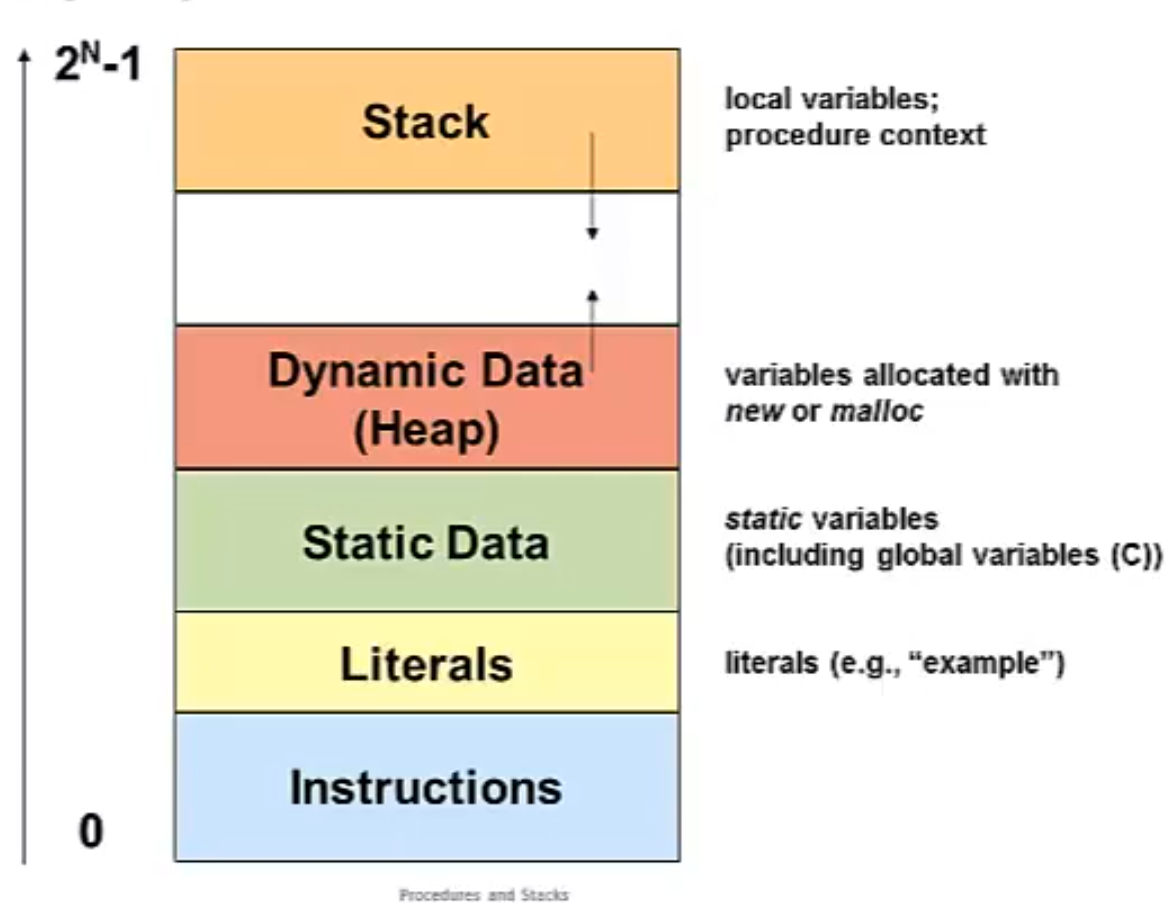
| Memory Permissions | Segment / Region | Management / Initialization |
|---|---|---|
| Writable; not executable | Stack | Managed automatically (by compiler/runtime) |
| Writable; not executable | Dynamic Data (Heap) | Managed by programmer |
| Writable; not executable | Static Data | Initialized when process starts |
| Read-only; not executable | Literals | Initialized when process starts |
| Read-only; executable | Instructions (Code) | Initialized when process starts |
IA32 Call Stack
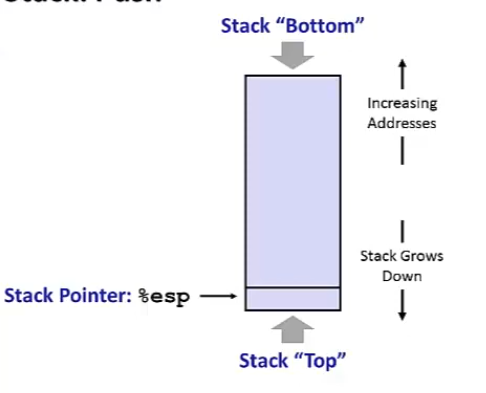
- Region of memory managed with a stack “discipline”
- Grows towards lower addresses
- Customarily shown “upside-down”
- Register
%espcontains lowest stack address = address of “top” element
IA32 Call Stack: Push
pushl Src- Fetch value from Src
- Decrement
%espby 4 (why 4?) It’s a push long(4 bytes of 32 bit word) - Store value at address given by
%esp
IA32 Call Stack: Pop
popl Dest- Load value from address
%esp - Write value to Dest
- Increment
%espby 4
- Load value from address
Procedure Call Overview
- Caller
...
<set up args>
call
<clean up args>
<find return val>
...
- Callee
<create local vars>
...
<set up return value>
<destroy local vars>
return
-
Calleemust know where to find args -
Calleemust know where to find “return address” -
Caller must know where to find return val
-
Caller and Callee run on same CPU -> use the sameregisters
- Caller might need to save registers that Callee might use
- Callee might need to save registers that Caller has used
-
Caller
...
<save regs>
<set up args>
call
<clean up args>
<restore regs>
<find return val>
...
- Callee
<save regs>
<create local vars>
...
<set up return value>
<destroy local vars>
<restore regs>
return
- The convention of where to leave/find things is called the
procedure call linkage- Details vary between systems
- We will see the convention for
IA32/Linuxin detail
Procedure Control Flow
- Use stack to support procedure call and return
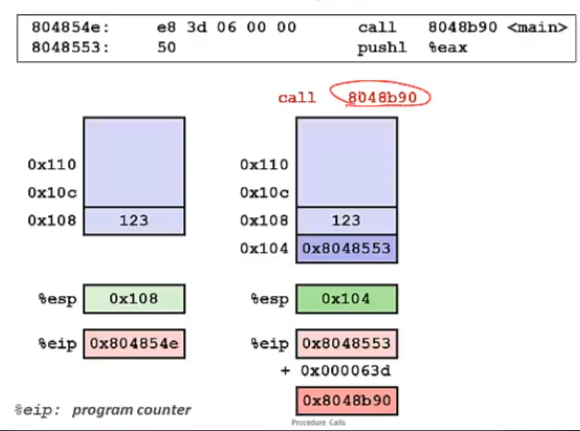
- Procedure call: call
label- Push return address on stack
- Jump to
label
- Return address:
- Address of instruction after call
- Example from disassembly:
804854e: e8 3d 06 00 00 call  8048b90 <main>
8048553: 50             push1 %eax
-
Return address = 0x8048553
-
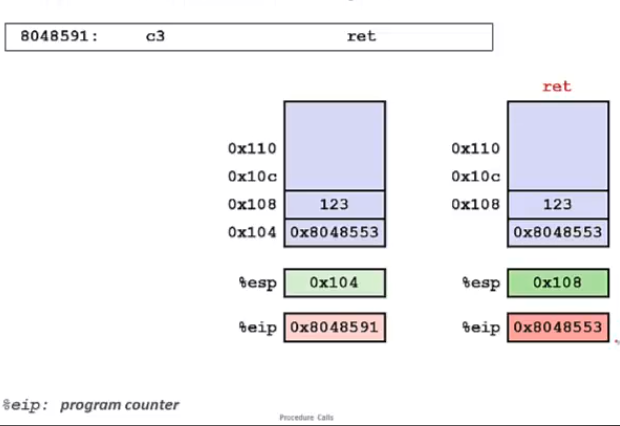
Procedure return:
ret- Pop return address from stack
- Jump to address
Procedure Call Example
Procedure Return Example
Return Values
- By convention, values returned by procedures are placed in the
%eaxregister- Choice of %eax is arbitrary, could have easily been a different register
- Caller must make sure to save that register before calling a callee that returns a value
- Part of register-saving convention
- Callee placed return value (any type that can fit in 4 bytes - integer, float, pointer, etc.) into the %eax register
- For return values greater than 4 bytes, best to return a pointer to them
- Upon return, caller finds the return value in the %eax register
Stack Based Languages
- Languages that support recursion
- e.g, C, Pascal, Go
- Code must be re-entrant
- Multiple simultaneous instantiations of single procedure
- Need some place to store state of each instantiation
- Arguments
- Local variables
- Return pointer
- Stack discipline
- Stack for a given procedure needed for a limited time
- Start from when it is called to when it returns
- Callee always returns before caller does
- Stack for a given procedure needed for a limited time
- Stack allocated in frames
- State for a single procedure instantiation
Call Chain Example
yoo(...)
{
    ...
    who();
    ...
}
who(...)
{
    ...
    amI();
    ...
    amI();
    ...
}
amI(...)
{
    ...
    amI();
    ...
}
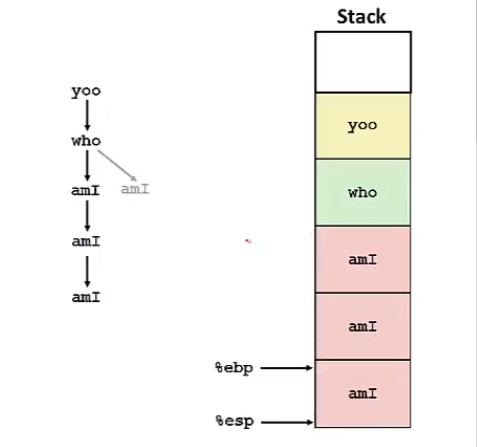
Example Call Chain
yoo
↓
who -> amI
↓
amI
↓
amI
- Procedure amI is recursive (calls itself)
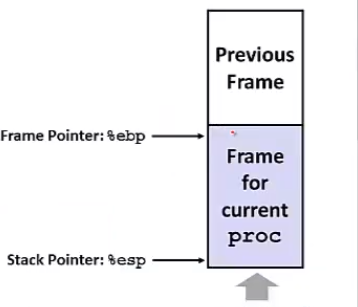
** Stack Frames **
-
Stack frame = portion of stack used for a single procedure instantiation
-
Contents
- Local variables
- Function arguments
- Return information
- Temporary space
-
Management
- Space allocated when procedure is created
- “set-up” code
- Space deallocated upon return
- “Finish” code
- Space allocated when procedure is created
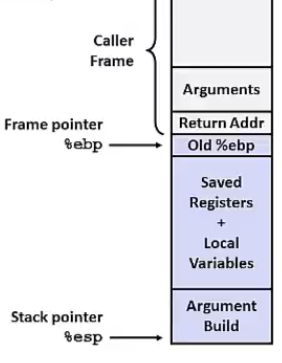
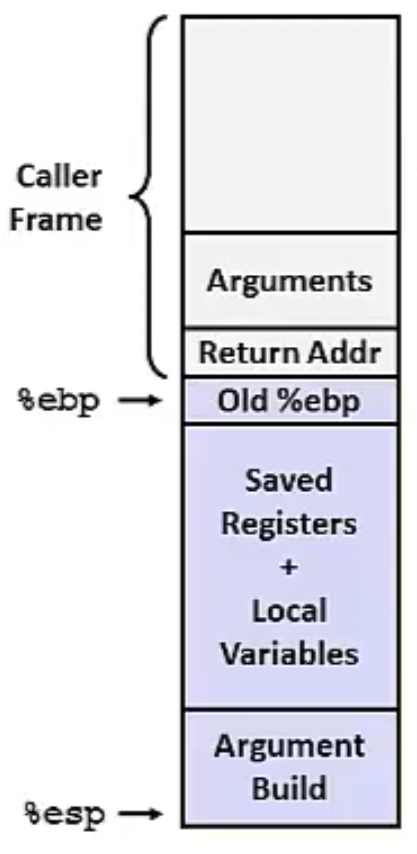
The Linux Stack Frame
-
Current Stack Frame (“Top” to Bottom)
- “Argument build” area (parameters for function about to be called)
- Local variables (if can’t be kept in registers)
- Saved register context (when reusing registers)
- Old frame pointer (for caller)
-
Caller’s Stack Frame
- Return address
- Pushed by
callinstruction - Arguments for this call
- Pushed by
- Return address
Revisting swap
int zip1 = 15213;
int zip2 = 98195;

void call_swap()
{
    swap(&zip1, &zip2);
}

void swap(int *xp, int *yp)
{
    int t0 = *xp;
    int t1 = *yp;
    *xp = t1;
    *yp = t0;
}
Calling swap from call_swap
call_swap:
    ...
    push1 $zip2  # Global var
    push1 $zip2  # Global var
    call swap
    ...
swap:
    # Setup
    push1 %ebp
    movl %esp, %ebp
    pushl %ebx

    # Body
    movl 12(%ebp), %ecx
    movl 8(%ebp), %edx
    movl (%ecx), %eax
    movl (%edx), %ebx
    movl %eax, (%edx)
    movl %ebx, (%ecx)

    # Finish
    movl -4(%ebp), %ebx
    movl %ebp, %esp
    popl %ebp
    ret
Allocating local variables on the stack
Register Saving Conventions
- When procedure
yoocalles who:- yoo is the caller
- who is the callee
- Can a register be used for temporary storage?
yoo:
    ...
    movl $12345, %edx
    call who
    addl%edx, %eax
    ...
    ret
who:
    ...
    movl 8(%ebp), %edx
    addl $98195, %edx
    ...
    ret
- Contents of register %edx overwritten by who
- Conventions
- “Caller Save”
- Caller saves temporary values in its frame before calling
- “Callee Save”
- Callee saves temporary values in its frame before using
- “Caller Save”
IA32/Linux Register Usage
# Caller-save Temporaries
%eax
%edx
%ecx

# Callee-save Temporaries
%ebx
%esi
%edi

# Special
%esp
%ebp
%ebp (Extended Base Pointer)
- The “Anchor”: Also called the Frame Pointer, it stays at a fixed location for the duration of a function.
- Stack Frames: At the start of a function, the old %ebp is saved, and the current %esp is copied into %ebp to “lock” the base of the new frame.
%esp (Extended Stack Pointer)
-
The “Mover”: Points to the very top (the current lowest memory address) of the stack.
-
Dynamic: its value changes automatically whenever you use push, pop, call, or ret instructions
-
Tracking: It keeps track of the next available space or the last item placed on the stack
-
Volatility: Because it shifts constantly during calcaltions or nested calls, it is difficult to use for finding specific variables
-
%eax, %edx, $ecx
- Caller saves prior to call if values are used later
-
%eax
- also used to return integer value
-
%ebx, %esi, %edi
- Callee saves if wants to used them
-
%esp, %ebp
- special form of calle save- restored to original values upon exit from procedure
Example: Pointer to Local Variables
- Recursive Procedure
void s_helper (int x, int *accum)
{
    if (x <= 1)
        return;
    else {
        int z = *accum * x;
        *accum = z;
        s_helper (x-1, accum);
    }
}
- Top-Level Call
int sfact(int x)
{
    int val = 1;
    s_helper(x, &val);
    return val;
}
- Pass pointer to update location
Creating & Initializing Pointer
int sfact(int x)
{
  int val = 1;
  s_helper(x, &val);
  return val;
}
-
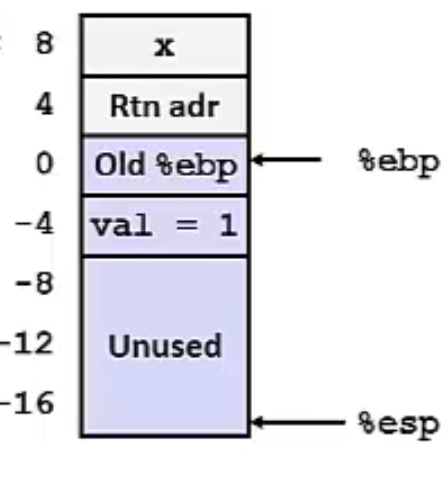
Variable
valmust be stored on stack- Because: Need to create pointer to it
-
Computer pointer as
-4(%ebp) -
Push on stack as second argument
-
Initial part of
sfact
_sfact:
  pushl %ebp            # Save %ebp
  movl  %esp, %ebp      # Set %ebp
  subl  $16, %esp       # Add 16 bytes
  movl  8(%ebp), %edx   # edx = x
  movl  $1, -4(%ebp)    # val = 1
- Calling
s_helperfrom sfact
leal  -4(%ebp), %eax  # Compute &val
pushl %eax            # Push on stack
pushl %edx            # Push x
call s_helper         # call
movl -4(%ebp), %eax   # Return val
...                   # Finish
- Important points:
- IA32 procedures are a combination of instructions and conventions
- Conventions prevent functions from disrupting each other
- Stach is the right data structure for procedure call / return
- If P calls Q, the Q returns before P
- IA32 procedures are a combination of instructions and conventions
- Recursion handled by normal calling conventions
- Can safely store values in local stack frame and in callee-saved registers
- Put function arguments at top of stack
- Result returned in
%eax
x86-64 Procedure Calling Convetion
- Doubling of registers makes us less dependent on stack
- Store argument in registers
- Store temporary variables in registers
- What do we do if we have too many arguments or too many temporary variables?
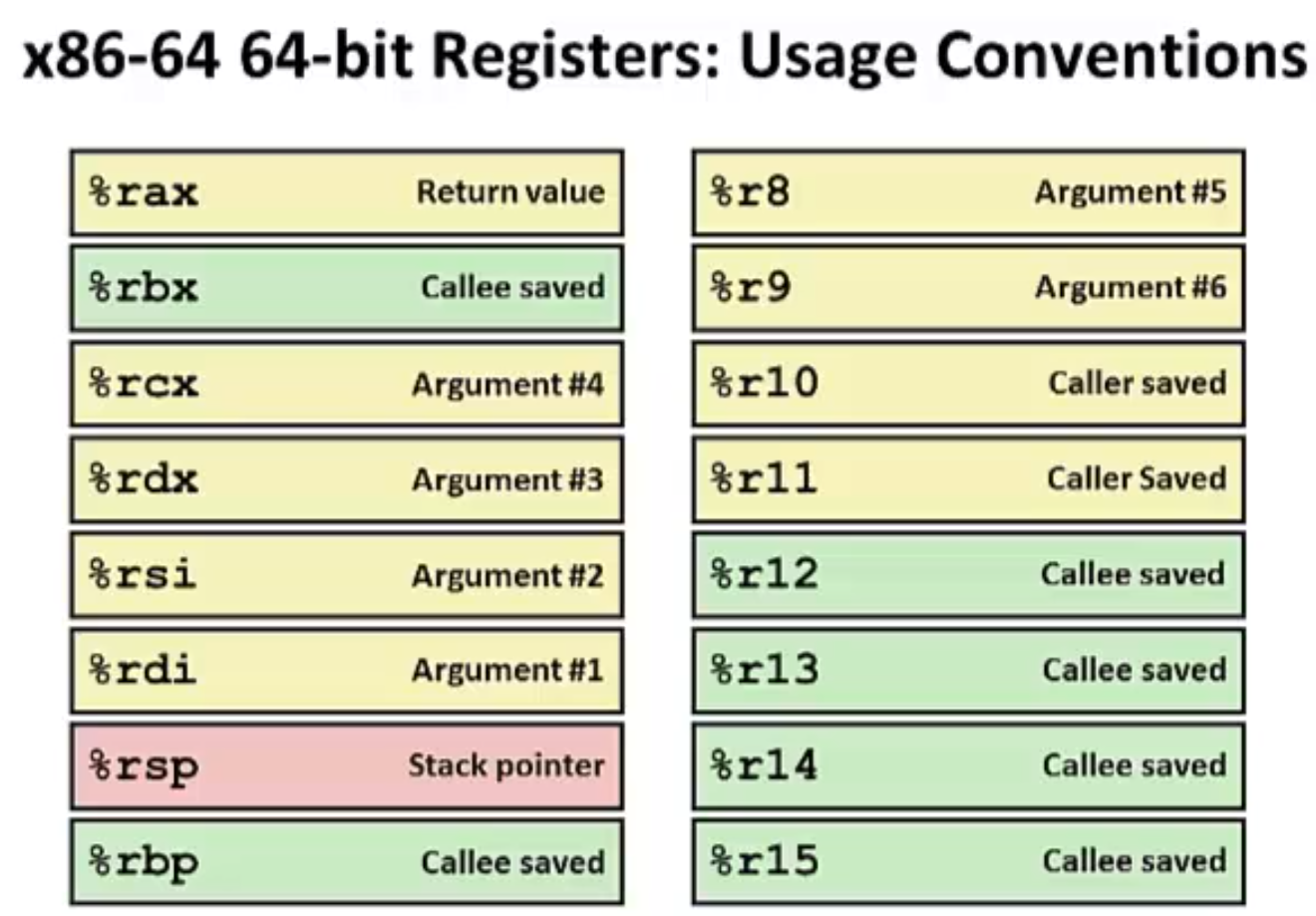
x86-64 64-bit Registers: Usage Conventions
| 64-bit | Usage Conventions |
|---|---|
| %rax | Return value |
| %rbx | Callee saved |
| %rcx | Argument#4 |
| %rdx | Argument#3 |
| %rsi | Argument#2 |
| %rdi | Argument#1 |
| %rsp | Stack Pointer |
| %rbp | Callee saved |
| %r8 | Argument#5 |
| %r9 | Argument#6 |
| %r10 | Caller saved |
| %r11 | Caller saved |
| %r12 | Callee saved |
| %r13 | Callee saved |
| %r14 | Callee saved |
| %r15 | Callee saved |
swap:
  // Set Up
  pushl %ebp
  movl %esp, %ebp
  pushl %ebx

  // Body
  movl 12(%ebp), %ecx
  movl 8(%ebp), %edx
  movl (%ecx), %eax
  movl (%edx), %ebx
  movl %eax, (%edx)
  movl %ebx, (%ecx)

  // Finish
  movl -4(%ebp), %ebx
  movl %ebp, %esp
  popl %ebp
  ret
swap (64-bit long ints):
  movq (%rdi), %rdx
  movq (%rsi), %rax
  movq %rax, (%rdi)
  movq %rdx,(%rsi)
  ret
- Arguments passed in registers
- First (xp) in
%rdi, second (yp) in%rsi - 64-bit pointers
- First (xp) in
- No stack operations required (except ret)
- Avoiding stack
- Call hold all local information in registers
X86-64 procedure call highlights
- Arguments (up to first 6) in registers
- Faster to get these values from registers than from stack in memory
- Local variables also in registers (if there is room)
callqinstruction stores 64-bit return address on stack- Address pushed onto stack, decrementing
%rspby 8
- Address pushed onto stack, decrementing
- No frame pointer
- All references to stack frame made relative to
%rsp; eliminates need to update%ebp/%rbp, which is now avaible for general-purpose use
- All references to stack frame made relative to
- Functions can access memory up to 128 bytes beyond
%rps: the “red zone”- Can store some temps on stack without altering
%rsp
- Can store some temps on stack without altering
- Registers still designated “caller-saved” or “calle-saved”
x86-64 Stack Frames
- Often (idelly), x86-64 functions need no stack frame at all
- Just a return address is pushed onto the stack when a function call is made
- A function does need a stack frame when it:
- Has too many local variables to hold in registers
- Has local variables that are arrays or structs
- Uses the address-of operator (&) to compute the address of a local variable
- Calls another function that takes more than six arguments
- Needs to save the state of callee-save registers before modifying them
x86-64 Procedure Summary
- Heavy use of registers (faster than using stack in memory)
- Parameter passing
- More temporaries since more registers
- Minimal use of stack
- Sometimes none
- when needed, allocate/deallocate entire frame at once
- No more frame pointer: address relative to stack pointer
- More room for compiler optimizations
- Prefer to store data in registers rather than memory
- Minimize modifications to stack pointer
- Stack: last in first out. reserved portion of memory for temporary storage of registers
- Stack pointer: contains an address pointing to the stack
- Increment/ Decrement
- Pre-increment / Pre-decrement
- Post -> Stack Pointer (SP) points to the next location to store a register value